Details
ISBN/EAN: 978-3-89937-196-3
Einband: gebundenes Buch
Weitere Details
Auflage:
1. Auflage 2015
1. Auflage 2015
Erschienen am:
24.09.2015
24.09.2015
Sprache:
English
English
Umfang:
92 S.
92 S.
Hersteller:
Verlag Dr. Friedrich Pfeil
Dr. Friedrich Pfeil
fritz.pfeil@pfeil-verlag.de
Hauptstraße 12 B
DE 85269 Bergkirchen OT Günding
Verlag Dr. Friedrich Pfeil
Dr. Friedrich Pfeil
fritz.pfeil@pfeil-verlag.de
Hauptstraße 12 B
DE 85269 Bergkirchen OT Günding
Weitere Details
arrow_forward_ios

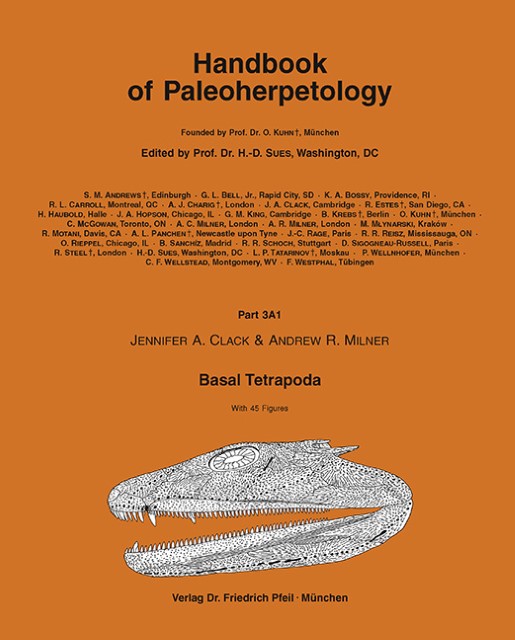
Handbook of Paleoherpetology / Basal Tetrapoda
Handbook of Paleoherpetology 3A1
60,00 €
inkl. MwSt.
Lieferbar innerhalb 1 - 2 Wochen
Beschreibung
Handbook of Paleoherpetology
Leseprobe
The last two decades or so there have witnessed a renaissance of scientific interest in the origin of tetrapods, driven by spectacular discoveries of fish-like sarcopterygians with tetrapod characters and very primitive tetrapods. This research has revolutionized our understanding of the sequence of acquisition of key tetrapod features as well as the timing and circumstances of critical events during this major evolutionary transition. The new finds have not only established the existence of an unexpected diversity of Late Devonian stem tetrapods but are also beginning to fill in a major hiatus in the fossil record, informally known as Romers Gap, during which tetrapods made the transition from a primarily aquatic to a terrestrial mode of life. The foremost expert in the study of origin and early diversification of tetrapods, Professor Jennifer A. CLACK, and a leading expert on late Paleozoic non-amniote tetrapods, Dr. Andrew R. MILNER, present here a synopsis of our current knowledge of the anatomy and diversity of Late Devonian and Carboniferous (Mississippian-Pennsylvanian) stem tetrapods. The phylogenetic relationships of many of the taxa included in this review remain unresolved, and thus the title basal Tetrapoda was selected faute de mieux. We are well aware that most authors would extend the tetrapod stem-group much farther into fish-like sarcopterygians such as Eusthenopteron. In the absence of suitable formal taxonomic categories, basal Tetrapoda is used here in a less inclusive meaning - tetrapodomorph taxa with limbs and digits that cannot be assigned to more derived clades such as Temnospondyli and Amniota or their respective proximate sister taxa.